The French Foundation Meets Hellenic Enrichment
When Nikolaos Tselementes imported béchamel into Greece, he recognized that an ordinary fluid white sauce would simply collapse into the aubergines during the prolonged baking period. To solve this, Greek cooks developed a heavier roux base and enriched the emulsion with egg yolks and hard, aged sheep and goat cheeses.
In the oven, the eggs undergo coagulation, puffing slightly like a soufflé and setting into a resilient custard capable of retaining clean knife cuts once cooled.
The Golden Roux: Ratios and Starch Gelatinization
Precision is vital. The standard Greek home ratio for an authentic moussaka crown is:
- 100g Unsalted European Butter (82% Butterfat)
- 100g All-Purpose Wheat Flour
- 1 Liter Whole Milk (Warmed to 50°C / 122°F)
- 3 Large Egg Yolks (Room Temperature)
- 120g Finely Grated Hard Greek Cheese (Kefalotyri or Graviera)
- 1 Whole Nutmeg, freshly grated to yield 1/2 teaspoon
Melt the butter in a heavy-bottomed Dutch oven over medium heat. Whisk in the flour and cook the paste for three to four minutes. You are aiming for a roux blanc with faint nutty aroma; do not let it brown, or its starch molecules will fragment and lose their thickening power.
Preventing Lumps: The Warmed Milk Cascade
Pouring ice-cold milk into hot roux shocks the butterfat, producing stubborn flour globules. Always warm your milk gently beforehand.
Pour one-third of the warm milk into the roux in a steady stream while whisking vigorously in circular motions. The mixture will initially seize into a thick ball. Keep whisking as you introduce the remaining milk in two gradual stages. Switch to a silicone spatula to scrape the corners of the pot. Bring the mixture to a slow bubble; continue cooking for two minutes until it coats the back of a spoon in a thick, velvety sheet.
The Science of Egg Tempering
Adding cold raw egg yolks directly to the boiling béchamel will cause the yolk proteins to instantly scramble into yellow flecks. To prevent curdling, follow the classic tempering method:
- Remove the saucepan completely from the heat source. Let it cool for five minutes until the temperature drops below 75°C (167°F).
- Whisk the 3 egg yolks together in a heatproof ceramic bowl with two tablespoons of warm milk.
- Slowly ladle one cup of warm béchamel into the yolk bowl while whisking continuously. This gradually raises the internal temperature of the egg proteins without denaturing them.
- Stream the tempered mixture back into the main pot, whisking briskly until fully incorporated and uniformly golden.
The Cheese Element: Kefalotyri vs. Graviera
The salt and pungency of the top crust are dictated by your cheese selection:
| Cheese Variety | Flavor Profile | Browning & Texture Result |
|---|---|---|
| Kefalotyri (Aged Sheep/Goat) | Sharp, salty, piquant, dry crystalline paste | Forms a deep bronze, crisp gratin shell with savory punch |
| Graviera (Cretan or Naxian) | Nutty, sweet, buttery, hints of caramel | Melts into a golden blistered glaze with silky elasticity |
| Pecorino Romano (Substitute) | Intensely salty, sharp, sheep’s milk base | Closest global alternative; reduce added salt slightly |
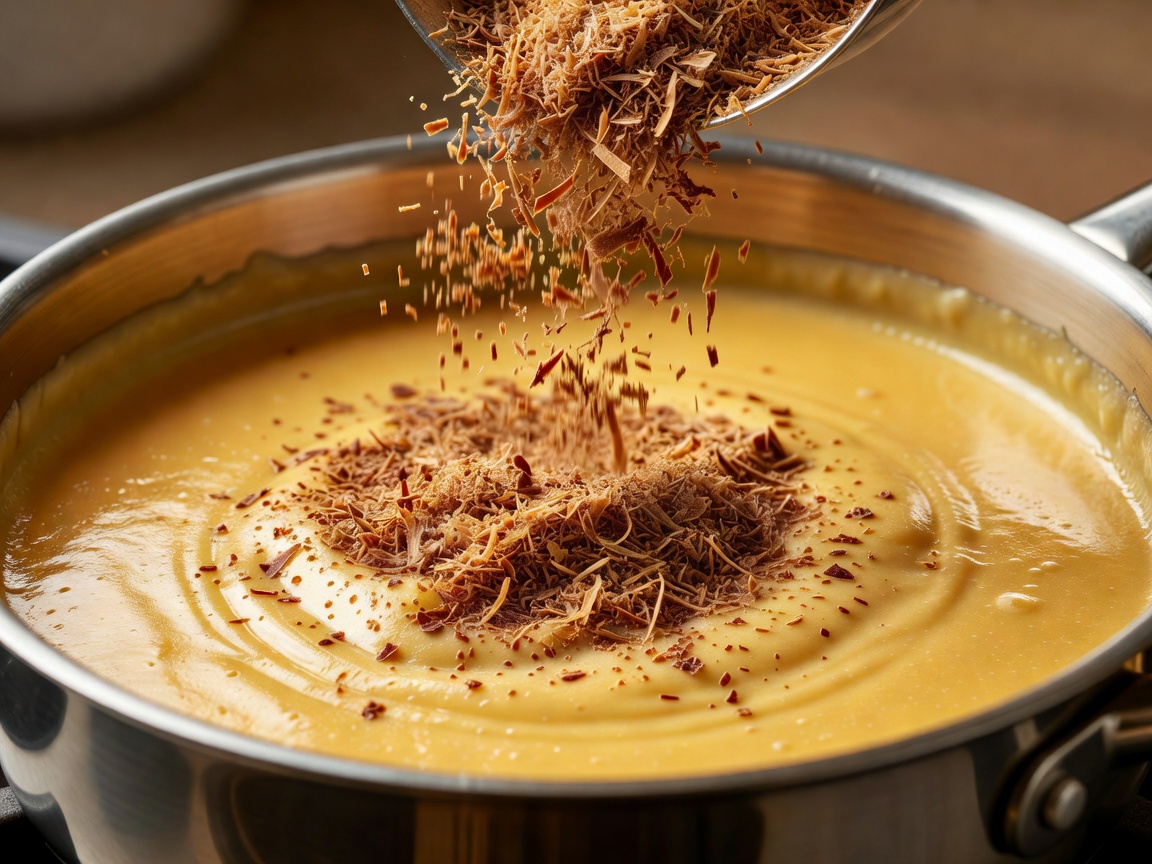
Stir two-thirds of the cheese into the warm sauce along with fresh grated nutmeg and white pepper. Reserve the remaining one-third to sprinkle across the assembled top before baking.