The Great Greek Debate: Potatoes at the Base
Purists who follow early twentieth-century aristocratic recipes insist that moussaka should consist purely of aubergines and meat beneath béchamel. However, in Greek family households and island tavernas, a single bottom stratum of parboiled or roasted sliced potatoes is almost universally adopted.
This is not merely a rustic filler; it is an ingenious structural foundation. Potato starch acts as a thermal buffer against direct heat from the bottom of the roasting pan. More crucially, as juices migrate downwards during baking, the potato slices absorb stray olive oil and tomato juices, preventing bottom pooling and providing a sturdy shelf for your spatula.
Pan Selection and Geometry
The choice of vessel determines heat distribution and portion stability:
- Optimal Dimensions: A 25cm × 35cm (10 × 14 inch) rectangular baking dish with straight vertical walls at least 7cm (2.75 inches) deep.
- Material Matters: Heavy enameled cast iron or high-fired ceramic provides even, gentle heat distribution that browns the base without scorching. Thin aluminum pans conduct heat too aggressively, burning the bottom layer before the béchamel develops its gratin.
The Five-Strata Assembly Blueprint
Follow this step-by-step layering sequence for structural perfection:
- The Pan Conditioning & Friction Coat: Lightly coat the pan with olive oil and dust the floor with two tablespoons of dry coarse breadcrumbs or fine semolina. This creates a non-stick moisture barrier.
- Strata 1 — The Potato Bed: Lay thinly sliced (5mm), roasted Yukon Gold or Russet potato rounds tightly across the floor in a single, overlapping shingle pattern. Dust lightly with a pinch of salt and dried wild oregano.
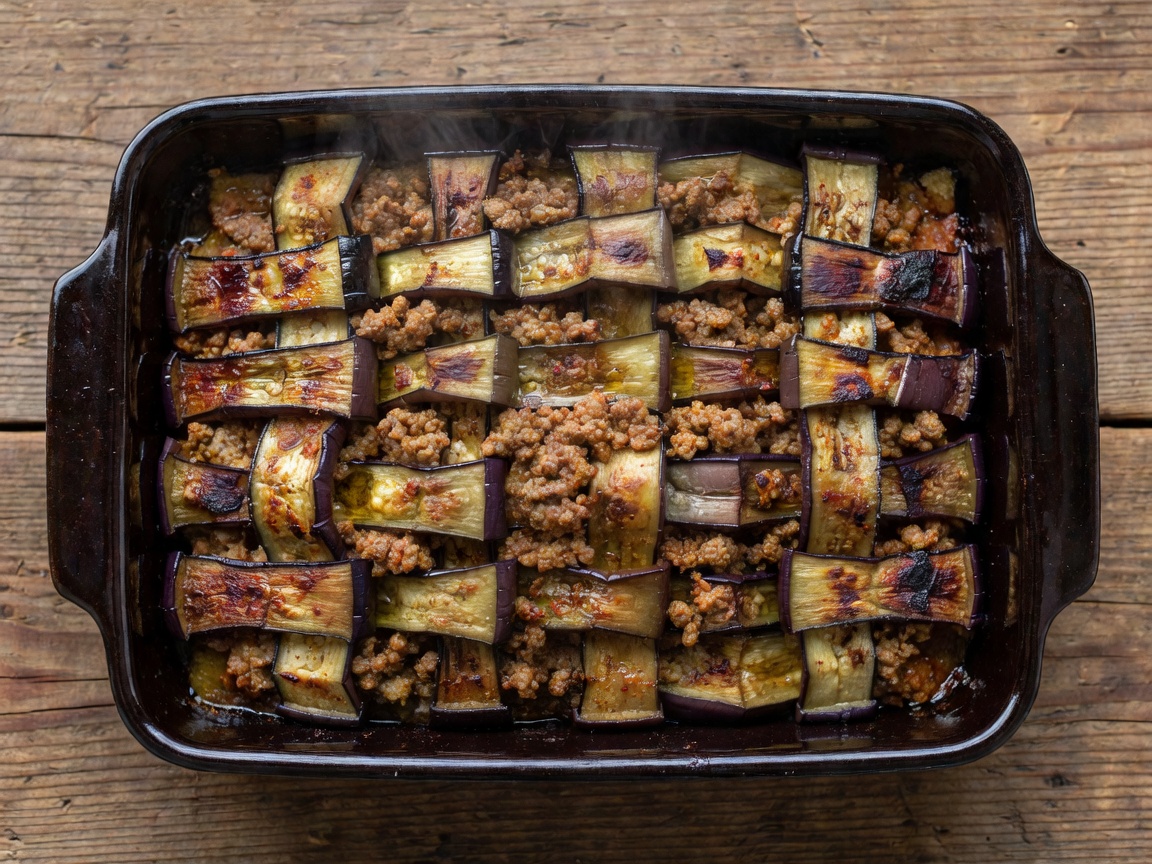
- Strata 2 — The Aubergine Interlock: Arrange half of your roasted eggplant planks lengthwise across the potatoes. Lay the second half crosswise (perpendicular). This cross-grain grid creates a structural matrix that prevents horizontal sliding.
- Strata 3 — The Breadcrumb Binder & Meat Pack: Sprinkle two tablespoons of breadcrumbs over the aubergines. Spoon the warm spiced meat ragù evenly over the top. Using an offset spatula, press the meat down firmly to compact out air pockets.
- Strata 4 — The Second Aubergine Tier (Optional) or Direct Crown: In classical deep casseroles, a second thin layer of roasted aubergines or sautéed zucchini rounds is placed over the meat. For modern proportions, many Greek masters prefer pouring the béchamel directly over the compacted meat.
- Strata 5 — The Béchamel Crown: Pour the warm, yolk-enriched béchamel gently over the meat, starting from the perimeter toward the center. Smooth the top with an offset spatula. Finish with the reserved grated Kefalotyri cheese.
Height Proportions and Volumetric Balance
Visual appeal depends on strict proportional balance:
| Layer Component | Proportional Depth | Function in Slice Architecture |
|---|---|---|
| Potato Foundation | 15% (~1.0 cm) | Absorptive base, spatula support, thermal shield |
| Roasted Aubergines | 35% (~2.2 cm) | Silky mouthfeel, earthy sweet vegetal core |
| Spiced Meat Ragù | 25% (~1.6 cm) | Dense savory anchor, aromatic spice reservoir |
| Béchamel & Gratin Cap | 25% (~1.6 cm) | Velvety richness, savory browned crust |
Common Assembly Pitfalls to Avoid
Never assemble hot meat onto cold, wet vegetables. Ingredients should all be warm or at room temperature during assembly. Uneven thermal states cause moisture condensation between layers, creating slippage when baking commences.