The Convection Thermal Environment
Preheat your oven to 180°C (350°F) in convection fan mode, or 190°C (375°F) in standard conventional mode. Position the oven rack in the lower third of the chamber. This ensures the heavier potato and eggplant base heats thoroughly before the cheese-laden béchamel browns prematurely.
Bake uncovered for 45 to 55 minutes. You are monitoring two distinct visual benchmarks:
- Edge Bubbling: Around the interior rim of the ceramic dish, the juices from the meat sauce and tomatoes should be gently simmering, sending small, aromatic volcanic bubbles along the edges.
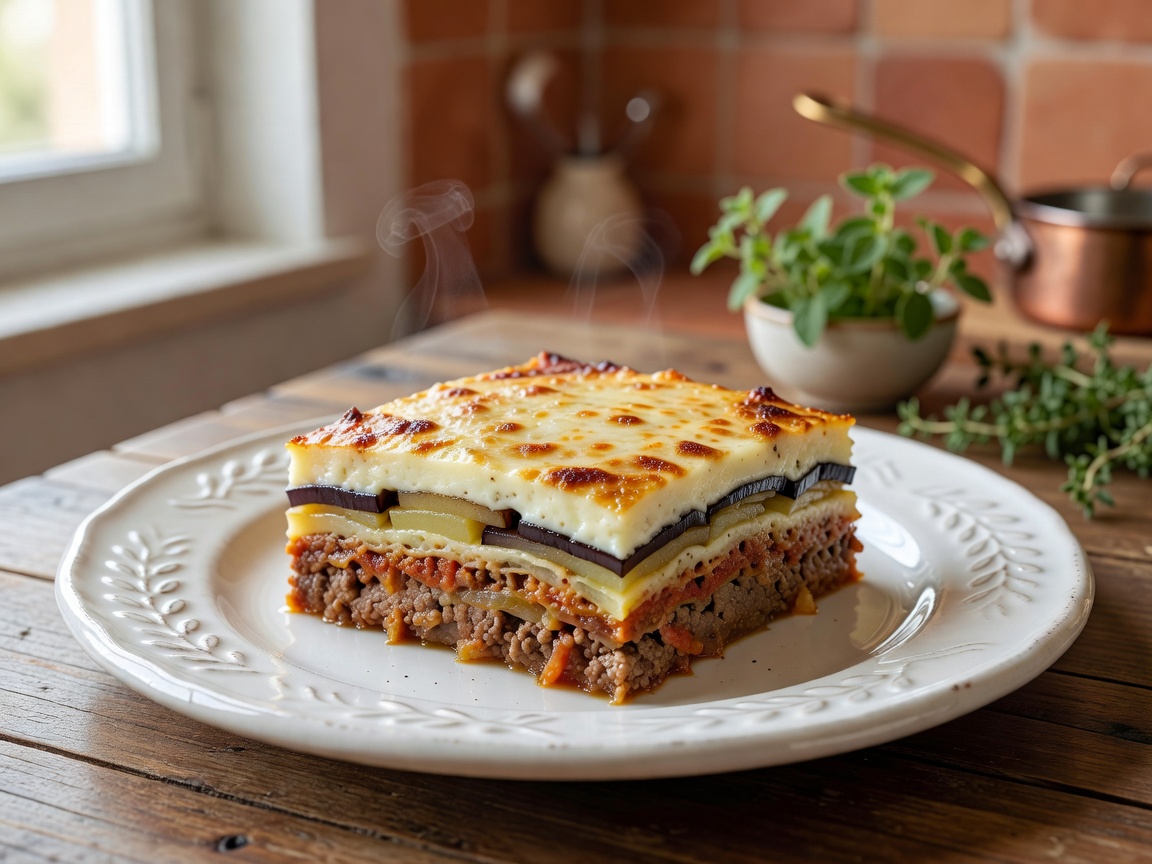
- The Maillard Gratin Shell: The béchamel must transition from creamy pale yellow to deep bronze, marked with tortoiseshell speckles where the grated Kefalotyri has caramelized. If the top has not developed golden mottling after 45 minutes, activate the overhead broiler on low for 2 to 3 minutes, watching continuously to avoid scorch marks.
The Science of Starch Retrogradation and Egg Coagulation
Why must moussaka never be cut straight out of the oven? The answer lies in basic food chemistry.
At 90°C to 100°C (194°F to 212°F), the starches in the potato layer, flour roux, and vegetable fibers are in an amorphous, hyper-fluid state. Similarly, the egg yolk proteins in the béchamel, while cooked, have not reached full structural rigidity. If a knife disrupts this molten matrix, the vertical walls of the slice cannot support their own weight, resulting in an unappetizing collapse.
As the dish rests at room temperature, temperature-dependent starch retrogradation takes place. Amylose and amylopectin molecules realign into semi-rigid crystalline networks. Concurrently, the fats in the lamb and cheese gently firm up, binding the meat granules and vegetable fibers into a cohesive unit.
The Sixty-Minute Rule
Place the hot baking dish on a wire cooling rack on your counter and walk away for a minimum of 45 to 60 minutes. Do not tent with foil, as trapped steam will soften the crisp gratin crust.
At the 60-minute mark, the internal core temperature will hover between 55°C and 60°C (130°F to 140°F) — the optimal serving temperature according to Mediterranean culinary tradition. Flavors of cinnamon, nutmeg, olive oil, and aged cheese become significantly more expressive at warm room temperature than when scorching hot.
Clean Portioning Technique
Follow this procedure to yield clean, picture-perfect slices:
- Use a long, razor-sharp chef’s knife rather than a serrated bread knife. Dip the blade into hot water and wipe dry before the first incision.
- Cut in smooth, single-draw downward strokes, wiping the blade clean between rows.
- Slide a wide, thin metal offset spatula cleanly beneath the bottom potato layer. Press down against the bottom of the pan to free the slice cleanly before lifting upward in one confident movement onto your plate.
Next-Day Maturation and Reheating
Like many complex Mediterranean stews and braises, moussaka is even more harmonious the following day. Over twenty-four hours in the refrigerator, the aromatic spices infuse through the eggplant flesh, and the layers settle completely.
To reheat leftover portions: Place chilled square cuts onto a baking sheet lined with parchment paper. Cover loosely with foil and warm in a 160°C (325°F) oven for 20 minutes. Remove the foil for the final five minutes to restore the crisp surface of the béchamel crust. Avoid microwave reheating, which turns the eggplant rubbery and splits the butterfat in the sauce.